Choosing an engagement ring: where to start
Choosing an engagement ring can feel overwhelming. It is in fact a series of small questions, and none of them has a wrong answer: there is only yours. This guide helps you make those choices, never with ready-made rules.
Where do you begin?
With the person, not the ring. How does she dress, what does she already wear, are her pieces discreet or bold, yellow, white or rose gold, silver? An engagement ring is worn every day: it should look like the person wearing it, not like a shop window. If you cannot put words to a taste, a picture test can reveal it better than a questionnaire, and ours is open without an account today. Take the taste test.
Should you ask her?
The question comes up more often than people admit. Two paths exist, and neither is better. A surprise keeps the gesture intact, but it asks you to know her taste well enough to commit to a piece she will wear for years. Choosing together takes away some of the uncertainty, and often produces a ring that feels more personal. A third way, less known, holds both: you prepare alone, show her at the last moment, and adjust it with her before ordering. A made-to-order ring lends itself to that, because everything can still change freely until the order is placed.
Should you settle a budget first?
A budget is not a confession, it is a frame that frees you. There is no salary rule, despite the legend: a beautiful ring exists at every price. Setting a range at the start lets you choose calmly inside it, rather than falling for a piece out of reach. Our price guide sets out what determines the price, item by item: What makes the price of a bespoke ring.
Which stone, and does it have to be a diamond?
The diamond remains the most common choice, for its hardness: it is the hardest natural material known, which matters for a ring worn every day, rubbing against everything, all day. But nothing makes it compulsory: sapphires, rubies and emeralds carry other stories, and their colour sometimes becomes the memory itself. These stones are softer than diamond and ask for a little more care, the emerald in particular, often veined with inclusions that make it more vulnerable to knocks. At LAB IMAGINE, both diamonds and coloured stones are laboratory-grown, and we always write it: Laboratory-grown diamonds, what they are.
Which stone shape will suit her?
Round, oval, pear, cushion, marquise: shape changes the character of a ring more than its value. A round is timeless, an oval lengthens, a pear shape adds character, a cushion softens, an emerald cut shows clarity rather than fire, because its wide facets return light in flat flashes instead of scattering it. No shape is reserved for an occasion: look at what she likes, not at what is done. And remember that at equal carat, two shapes do not cover the same surface on the finger: an oval diamond often reads larger than a round diamond of the same weight.
How wide should the band be?
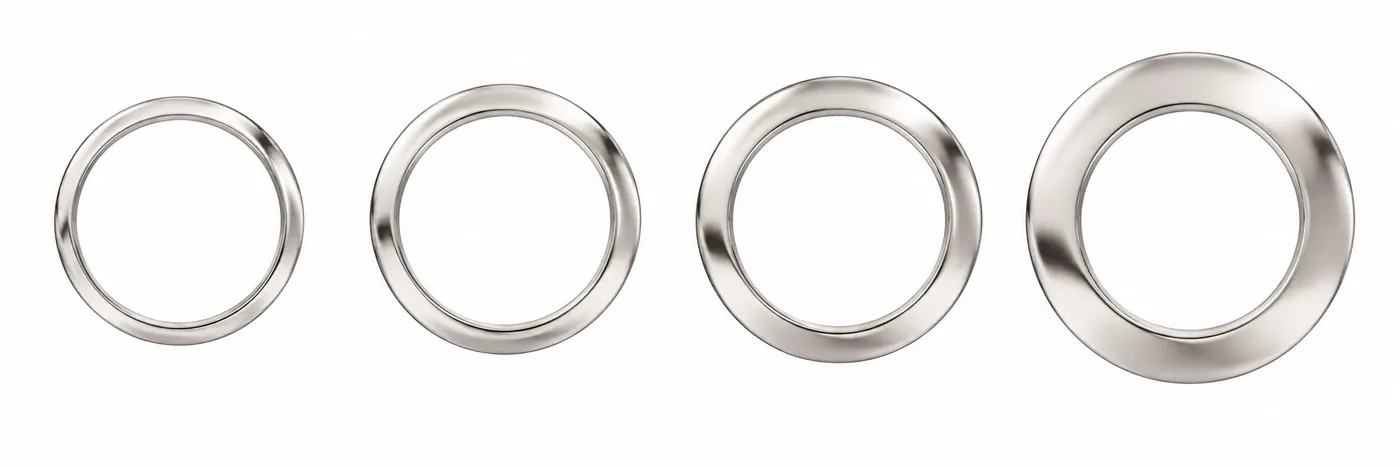
This is the detail people forget, and it changes everything in the wearing. A fine band, around two millimetres, stays discreet and lets the stone speak. Around four to six millimetres, the ring takes on presence and is happily worn alone. Beyond that, it becomes a statement. Width also decides daily comfort: a wide band spreads pressure over more of the finger, but leaves less room to pass the knuckle. And it decides how a wedding band will sit beside it later: Ring styles explains what does, and does not, let a band sit flush.
How can you be sure of the size?
It is the most practical question, and several reliable methods exist: our size guide sets them out. Remember above all that a wide ring feels tighter than a fine one at the same size, because it hugs more of the finger, and that fingers change with cold and at the end of the day: a half size, easily. Always take the band’s width into account when measuring ring size.
And if you still get it wrong?
Resizing depends on the model. Rings heavily pavé-set all the way round are difficult, large resizes too, and some rings, enamelled ball models in particular, do not allow a traditional resize. Depending on the construction, a reduction in size can sometimes be achieved by fitting a sizing band inside; that solution has to be confirmed by the workshop, and it cannot make a ring that is too small any larger. One more reason to talk about size before choosing the setting, not after.
A try-on ring can be ordered from your creation, €95 including VAT and delivery. It is a three-dimensional print, made to your finger size and from the image you approved. It is not a piece of jewellery: no precious metal, no stone, no finish, and it is not made to be worn for long. It does one thing, and does it well: letting you feel the volume and proportions on the finger before ordering. It says nothing of the weight or the sensations of the finished piece, it is light where gold is not.
Three things to know before ordering it: you receive one try-on ring; the house ships it to you; and because it is made to your size and from your creation, it carries no right of withdrawal, as with any personalised item. That takes nothing away from your guarantees if it arrives damaged or not as described: write to us and we will remake it. In exchange, its price is deducted from the piece if you order the ring it came from within three months.
Until when can you change your mind?
There are three moments, and it helps to tell them apart.
Before the order, everything can change freely: the stone, the metal, the width, the shape. The price follows each choice, immediately. That is when you hesitate, show, and start again.
The order settles the choices and fixes the price. Receipt of the deposit makes it firm, and that is when the production time starts.
Then comes technical approval: the workshop prepares the three-dimensional model of your ring, and you approve it before production begins. After the order, some adjustments remain possible during approval of the 3D model, subject to confirmation by the workshop. Any change affecting the price or the lead time is submitted to you for agreement beforehand.
And if no existing ring looks like her?
That happens more often than you would think, and it is exactly why LAB IMAGINE exists. You can create the ring yourself, made to order: describe it or compose it step by step, watch it appear as an image, check that it can be made and know its price while you create. Start imagining a ring.
The piece is then made by our partner workshops in Italy and France and delivered worldwide within six to eight weeks from receipt of the deposit. The clock stops between the moment we send you the 3D design and the moment we receive your approval; we then update your delivery date and tell you what it is. Count that into your calendar: a date that approaches is met more calmly two months ahead.
Take the taste test · Start imagining the ring