Recycled gold, and what it changes
"Recycled gold" is a phrase people think they understand, and it deserves better than an intuition. Here is what it means, where it comes from, what it changes, and what it does not.
What does recycled gold mean?
Gold already extracted, returned to the stream of raw material instead of being taken from a mine. Two quite distinct operations hide behind the phrase, and confusing them misleads.
Refining brings the metal back to purity: it is melted, stripped of its other metals, then alloyed to a stated fineness again. Refined and re-alloyed gold is a controlled raw material, at a guaranteed fineness.
Simply remelting an existing alloy is another matter: it does not automatically restore its characteristics. The composition may have drifted, oxides and impurities accumulate, and the pour can trap porosity. A remelt therefore calls for analysis, adjustment and checking before it is used for a new piece. That is why our rings start from gold that has been refined and re-alloyed, not from an improvised remelt.
Gold is stated in thousandths: 750 thousandths contains 75% pure gold, 585 thousandths contains 58.5%.
Where does it come from?
From four main sources. Old jewellery, bought back and melted down, which forms the bulk of the volume. Workshop scrap, because a jeweller never throws away gold filings: they go back to the refiner. Gold from silverware and professional use, from service pieces to dental equipment. And the gold contained in electronic components, present in very small quantities but in enormous volumes of hardware. All of it takes the same road: collection, melting, refining, re-alloying.
Does it change anything about the ring?
No, provided it has been refined and checked. Gold is a metal that melts down without degrading: its nature does not change on the way. A ring in recycled 750 gold is a ring in 750 gold, with the same fineness and the same behaviour. The hallmark states the fineness; it does not have to tell the story of the metal, because that story changes nothing about the piece.
So what does it change?
It changes the origin of the material, and that is a documented choice, not a universal guarantee.
What can be said with certainty: this gold does not come from new extraction, and its recycled origin can be documented by the supplier. What cannot be said: that it reduces extraction by the same amount. World demand for gold does not follow from one purchase, and no one can claim that a recycled gram replaces an extracted one.
And recycling does not erase the conditions of the original extraction. Recycled gold was extracted one day, somewhere, in conditions that melting does not correct.
That is why we speak of a documented choice of material, and not of "clean" gold or gold "without impact": professional guidance on environmental claims is strict, and rightly so.
How do we source it?
Our partner workshops buy their gold from certified suppliers; on request, the supplier can certify its recycled origin.
Yellow, white, rose: where does the colour come from?
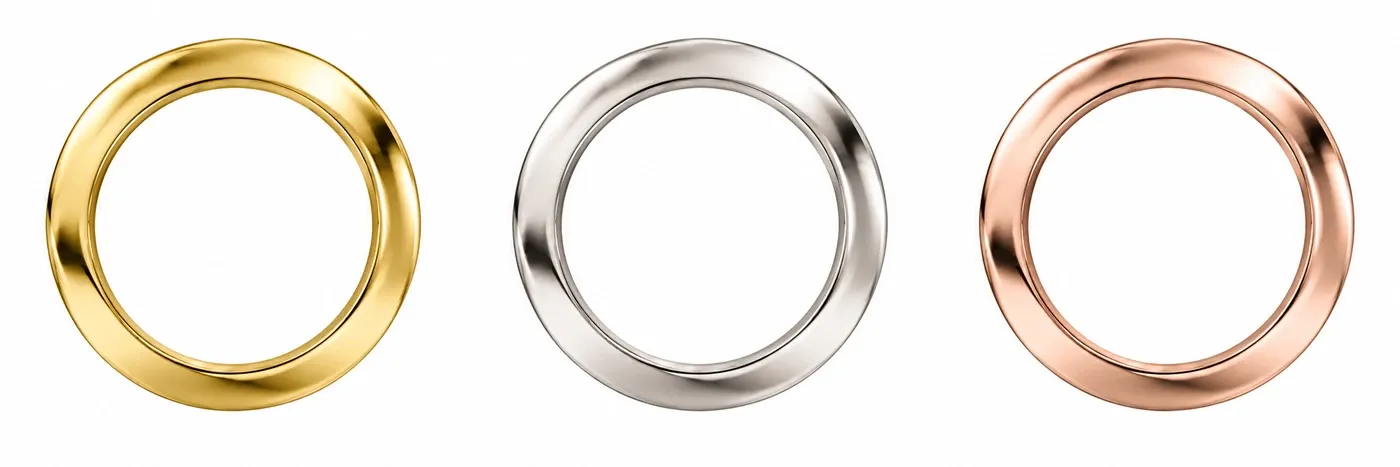
From the alloy. Pure gold is yellow and too soft for a ring worn every day: other metals are added, which harden it and decide its hue. More copper and gold turns towards rose; more silver and palladium and it pales towards white; yellow gold keeps a balance close to the colour of the pure metal.
One point is worth knowing before choosing: white gold is most often rhodium-plated, that is, covered with a fine layer of rhodium that gives it its cool brightness. That layer wears with friction and is redone in the workshop, generally every few years depending on wear. It is neither a fault nor a surprise, provided you know.
Is recycled gold cheaper?
No, and it does not claim to be: recycled gold trades at the gold price. That is not where its interest lies. In the price of a ring, what counts is the weight of the metal and its fineness: our price guide sets out how that comes together, What makes the price of a bespoke ring.
Which metals does the house work in?
Recycled 18K and 14K gold (750 and 585 fineness), in the three colours, alongside 950 platinum and 925 sterling silver.
How do you care for a gold ring?
Simply, and regularly. Warm water, a drop of mild soap, a soft brush to reach behind the stone: soiling, particularly under the stone, dulls its brilliance. Take rings off for housework, DIY and the swimming pool: chlorinated products attack alloying metals and can weaken a setting.
A worn ring picks up scratches, and its edges soften over the years: that is the normal life of a piece. Polishing gives back its brightness, but it removes a fine layer of metal: it should stay occasional. Well worn and polished now and then, a gold ring goes through a lifetime without difficulty.
Take the taste test · Start imagining the ring