Ring styles, and how to tell them apart
Being able to describe what you like is a useful first step. Ring styles are not boxes: they are bearings, families of shapes that keep coming back because they work. Here are the main ones, so you can recognise what speaks to you.
The solitaire
A single stone on a band: one of the great classics, and the most legible. All the attention goes to the stone, the band keeps quiet. A solitaire can be set high, the stone clear of the finger, or close to the finger, plainer for everyday. Its simplicity is demanding: since nothing distracts the eye, the quality of the stone and the neatness of the setting show entirely.
The halo
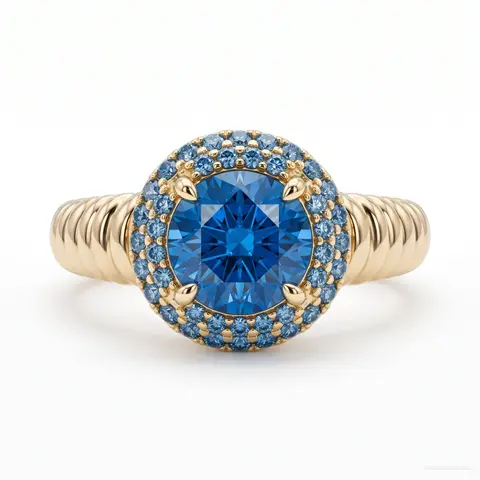
A centre stone encircled by small stones. The halo increases the visual presence of the whole: the centre stone reads larger, and the ring covers more of the finger. It can be discreet, almost a line, or emphatic. People love it for its sparkle; they leave it sometimes for its presence.
Pavé
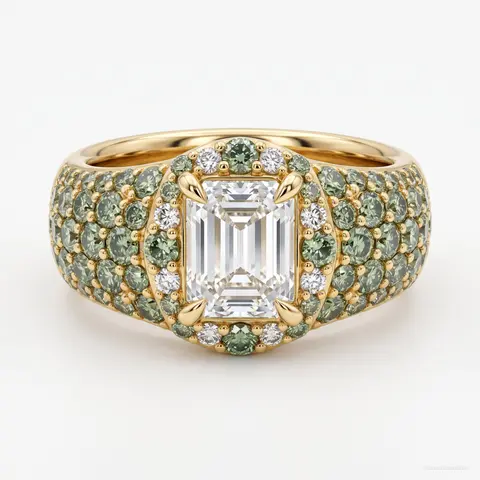
Small stones set side by side along the band, sometimes covering it. Pavé dresses the ring in light without imposing a centre. Successful pavé relies on precise setting and a balanced arrangement of stones: the stones can be of one size and perfectly aligned, or of varied sizes as in a snow setting, where the irregularity itself makes the texture. Worth knowing before choosing: a fully pavé band is difficult to resize, because the stones occupy the material that would have to be worked. Depending on its construction, the ring can sometimes be made smaller by fitting an inner sizing band, subject to confirmation by the workshop.
Three-stone rings
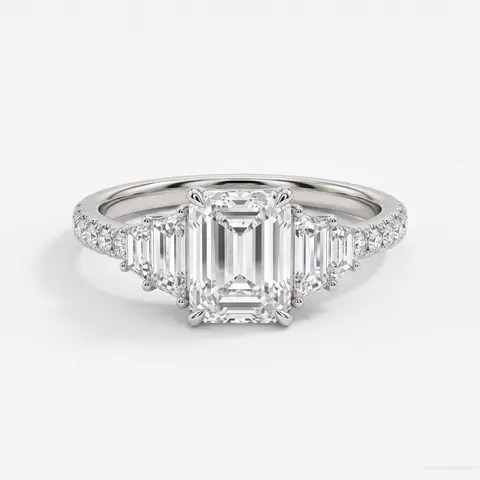
A centre stone framed by two side stones, often called a trilogy. The side stones can echo the shape of the centre or contradict it, two pear stones framing a round stone for instance. The difficulty lies in the agreement of the three: proportions that answer one another, regular transitions, an ensemble that reads as one piece and not as three stones placed together. Nothing requires the three tables to sit at the same height; that is a choice, not a rule.
The toi et moi
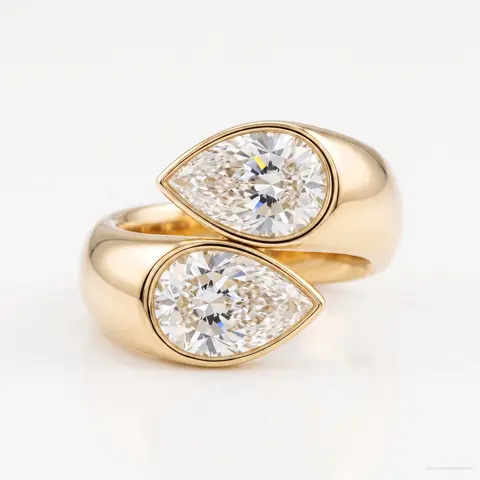
This is a family of its own, not a variant of the trilogy. Two stones alone, side by side, with no centre stone: the composition is organised around their meeting, often as two scrolls that cross. The two stones may differ in shape, colour and dimensions: a pear stone and a round stone, two different sizes, two hues. It is an old form, back in use, and it leaves great freedom because nothing imposes symmetry.
Sculptural rings
Some rings are volumes first: a dome, an arch, an organic form that follows the finger. The stone takes part in the whole rather than dominating it. These pieces ask for more refinement, because the volume must stay comfortable and hold up in wear.
The signet ring
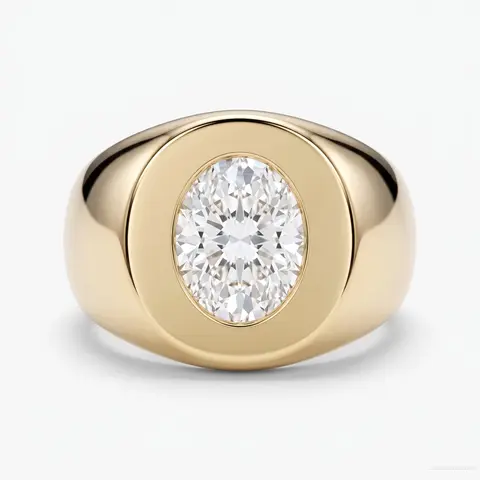
A flat or slightly domed top, traditionally worn on the little finger or the ring finger. The top can stay bare, take an engraving, a motif or a stone set flush. It is an everyday ring, robust, whose weight concentrates on the top of the finger.
The wide band
A wide, straight ring, from three to eight millimetres. It can be smooth, hammered, brushed, engraved, carry a line of stones, or take a centre stone set flush. Its strength is its surface: the finish gives the band its character, and catches the light.
The domed ring
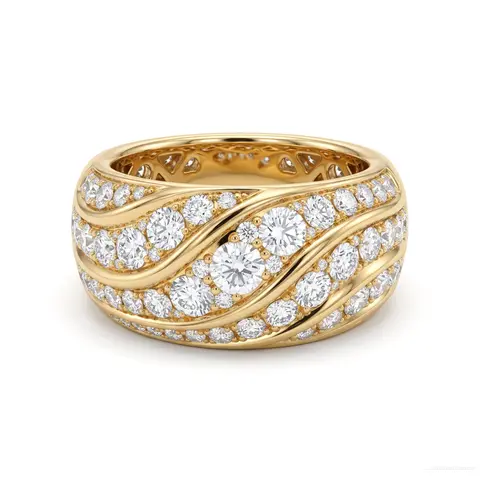
A ring whose profile rounds strongly outwards, an accentuated half-round or a true dome. It gives a full presence, with or without a stone. Its weight of metal depends on its construction: a solid dome carries more material than a flat band of the same width, a hollowed dome far less.
The open ring
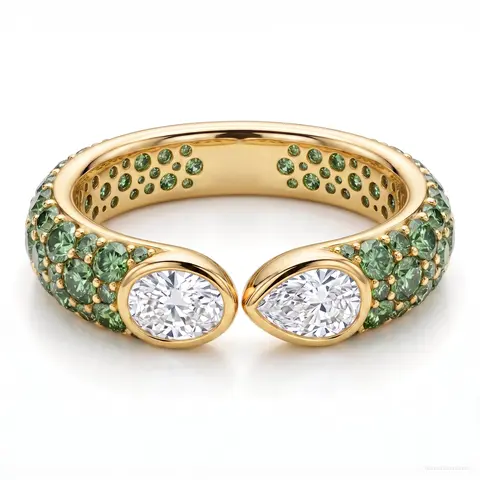
The two ends of the band do not meet: they cross, spread apart, or each finish in a motif or a stone. Its adjustment depends on its construction, and it should be checked with the workshop: some openings can be reworked, others cannot. An open ring also asks for a metal rigid enough to keep its shape in wear.
The setting, the detail that changes everything
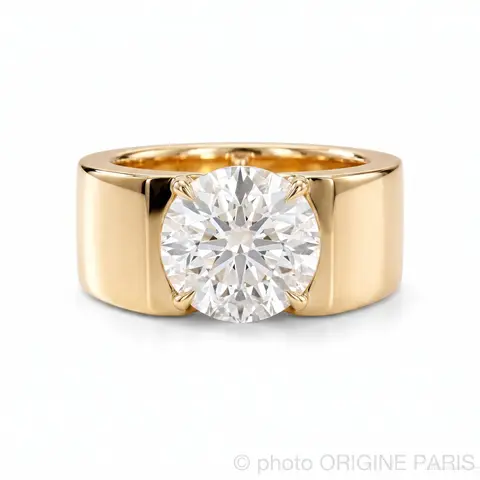
The setting is how the stone is held, and it does a great deal for the look. Claws hold the stone at a few points of metal and leave its sides clear: light reaches it from more directions. Height, however, comes from the mount and not from the setting: claws can raise a stone high or hold it close to the finger. A bezel surrounds the stone with a continuous border of metal: that border protects its edges from knocks and gives a smooth profile that catches neither fabric nor hair, which is why it is often chosen for working hands. Its brilliance depends on the height of the border, the opening left beneath the stone and the stone itself: a well-built bezel can be very bright. Channel setting aligns stones between two walls; grain setting holds them with tiny beads of metal raised with a graver.
Minimal, classic, romantic: what do these words mean?
They are temperaments more than styles: minimalism removes what is not necessary; the classic takes up proportions that have been tested; the romantic likes detail, curve, ornament. One and the same shape, a solitaire for instance, is drawn in each of these temperaments according to the fineness of the band, the height of the head and the treatment of the surfaces.
And the wedding band, later?
The question is rarely asked at the right moment, which is now. What decides is not the height of the stone alone, but the space available under the setting and its geometry. A stone set close to the finger guarantees nothing: a low basket, claws that reach down or a wide gallery can block the path of a straight band. Conversely, a high but open setting sometimes lets the band sit flush without difficulty.
Three outcomes exist, and none is a failure: a straight band if the space allows; a band drawn to follow the contour of the ring; or an accepted gap between the two, which many people find beautiful. Knowing it today saves a surprise in a few years.
Which style is worn every day?
All of them, provided you know what each one asks. A high stone catches the light, and also pockets, knits and hair. Pavé asks for more regular cleaning: soiling, particularly under the stones, dulls their brilliance. A wide band leaves less room to pass the knuckle and feels warmer on the finger; a fine band deforms more easily under a knock. None of these facts forbids anything: they help you choose knowingly.
How do you know which is yours?
By looking, more than by thinking. Our taste test, open without an account today, shows you rings and picks up what recurs in your choices: the result is your taste profile, often truer than what you would have declared. Take the taste test.
And if your style fits no family, that is good news: you can create the ring yourself, made to order, and watch it appear before deciding. Start imagining a ring.
Take the taste test · Start imagining the ring